Message from the AAMA Board

From Integration to Impact: Why Research Must Drive the Next Era of Medical Acupuncture

— By Stephanie I Cheng, MD, FAAMA, AAMA Board of Directors

In clinics and hospitals across the country, physicians are integrating acupuncture into pain management programs, perioperative pathways, oncology services, and primary care models. At the same time, federal investment in complementary and integrative health research continues through the National Center for Complementary and Integrative Health (NCCIH), whose annual budget now exceeds $170 million. Acupuncture-related studies increasingly examine opioid reduction, functional recovery, neuroimmune mechanisms, and health system outcomes. And yet, despite growing clinical integration and sustained federal funding, acupuncture remains variably understood by both the public and the broader scientific community. The path forward is clear: if medical acupuncture is to secure durable credibility within modern medicine, research must lead the way.

The question is no longer whether acupuncture “works.” Decades of trials and systematic reviews have demonstrated benefit for a range of conditions, particularly chronic pain disorders. What defines the next phase of inquiry is not simple efficacy, but integration and impact. Future facing research must address its role in opioid-sparing and multimodal pain strategies; its effects on sleep, autonomic regulation, and neuroimmune pathways; functional outcomes and quality of life metrics; and cost-effectiveness within value-based care models. These are the questions that resonate with health systems, policymakers, and funding agencies. They are also the questions that move acupuncture from adjunct to infrastructure.

We all want to shout it from the rooftops: ACUPUNCTURE WORKS! We use it. We believe in it. We see its impact every day in our patients. But visibility is not achieved through advocacy alone. It is earned through methodological clarity, reproducibility, and thoughtful collaboration.

Medical acupuncturists are uniquely positioned to advance this work. Our training allows us to frame research questions within biomedical paradigms, design pragmatic trials embedded in real-world clinical workflows, measure outcomes meaningful to both patients and institutions, and engage interdisciplinary collaborators. When acupuncture studies are conducted across diverse practice settings, in private clinics, in community hospitals, academic centers, and multidisciplinary practices, the signal then shifts. Acupuncture becomes not an alternative concept, but a measurable clinical variable worthy of rigorous evaluation.

This shift matters, not only for funding, but more importantly, for perception. Credibility in medicine is inseparable from transparency and data.

Patients today are increasingly sophisticated consumers of healthcare. They seek interventions that are evidence-informed, safe, and integrated within conventional systems. High-quality physician-led research strengthens public trust by demonstrating that acupuncture is not positioned outside science, but within it. In an era shaped by skepticism toward expertise, well-designed and well-communicated research serves as both shield and bridge: a shield against dismissal, and a bridge toward broader acceptance.

As I close out this guest piece, I’ll leave you with a simple call to action: If medical acupuncture is going to evolve over the next decade, research cannot remain the work of a small circle of investigators. It has to become something we all see as part of our professional responsibility. That doesn’t mean everyone needs to run a randomized trial. It might mean collecting outcomes in your own practice. Joining a multicenter collaboration. Publishing a case series. Mentoring a trainee who is curious about research. Asking better questions about the work we already do. Large-scale transformation rarely begins with sweeping policy changes. It begins with disciplined inquiry, sustained collaboration, and the willingness to measure what we value. If we all commit to that, the visibility and credibility of medical acupuncture will follow.

Upcoming Professional Development & Educational Opportunities

AAMA Pre-Sympoisum Workshops
April 23, 2026, Denver, CO

  • Applied Clinical Mastery in Medical Acupuncture: Advanced Pattern Differentiation & Specialized Techniques
  • Heart and Soul of Medical Acupuncture
  • Pragmatic Acupuncture in Any Setting

AAMA Annual Symposium
April 23-26, 2026
Denver, CO

Acupuncture in Oncology
ICMART – FREE WEBINAR
Mary 10, 2026 at 11am

ICMART World Medical Acupuncture Congress 2026
November 6-8, 2026
Istanbul, Turkey

The Dance of Diagnosis and Treatment in Acupuncture: Utilizing Tools from Manual Medicine
Instructors: Daniel Bensky, DO, and Jay Sandweiss, DO
October 2-4, 2026
Santa Rosa, CA

AAMA Website: Education Listings
The AAMA maintains an ongoing calendar of educational events and professional development opportunities related to medical acupuncture. The calendar is accessible on the AAMA website. Members are encouraged to share events and calendar items from their regions and about educational topics that may be of wider interest among peers and fellow AAMA members.

AAMA News & Announcements

Welcome Our Returning AAMA Member

Please join us in welcoming the following member who became part of the Academy in February  2026:

  • Lazaro Sanabria Gonzalez, MD of Pembroke Pines, FL
And a very warm welcome to a new student member member:
  • Katherine K. Zhang of Detroit, MI

If you have peers or colleagues who aren’t currently members of the AAMA, please encourage them to learn more about the benefits of membership by visiting the website or contacting Russell Corcoran, the membership committee chair.

Legislative Committee Report

The Legislative Committee receives daily updates on bills pertaining to acupuncture, chronic pain, and dry needling. They are currently following 100+ such bills.

Of note this month:

  • The committee wrote to the Maryland Secretary of the Department of Health regarding requirements for auricular detoxification specialists.
  • The committee contacted the authors of NY bills A10187 and S09223 to clarify requirements for continuing education for acupuncturists.
  • The AAMA has signed as a supporting organization for the Advancing Research for Chronic Pain Act. This bill will be introduced later in March.

REMEMBER: The committee members will contact you when legislation in your state may affect your ability to practice acupuncture. In that event, you are encouraged to write your representatives and senators since they prefer to hear directly from their constituents. If you learn of relevant legislative activity, please connect with the committee by email: info@medicalacupuncture.org.

TIME IS RUNNING OUT: Register Now for the 2026 Annual Symposium!

REGISTER NOW 

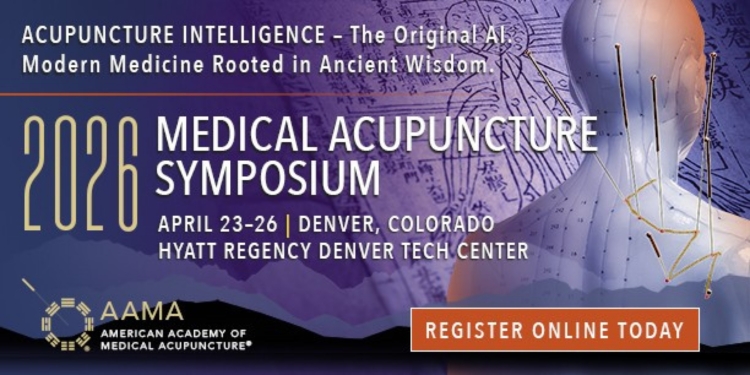
The Annual AAMA Symposium will be held April 23-26, 2026 at the Hyatt Regency Denver Tech Center in Denver, CO. The theme of the meeting is Acupuncture Intelligence-the Original AI: Modern Medicine Rooted in Ancient Wisdom.

The program will focus on a diverse array of topics that are of interest to health care professionals engaged in, or interested in, incorporating medical acupuncture in their practice. The program includes three days of morning plenary presentations, and afternoons feature concurrent workshops on relevant topics. A number of popular annual events will return for the meeting. These include the Founders Lecture, Poster Presentation session and plenty of opportunities for networking with colleagues and exhibit companies.

In-Person or Virtual/Hybrid options – make your selection during the registration process. Pricing is the same for both options.

Don’t miss this chance to re-connect with friends and meet peers from across the country!

Last Chance! Symposium Hotel Block Expires Tomorrow

(Deadline is 3/31/26 or when block sells out.)

  • AAMA Discount rate – $159+ tax/night
  • Discount deadline is March 31, 2026
  • Book Now!

Pre-Symposium Workshops — Save your Spot!

Choose from three hands-on accredited sessions presented by some of the AAMA’s most popular speakers. Workshops will be held Thursday, April 23, prior to the start of the Annual Symposium. REGISTER NOW.

  • “Applied Clinical Mastery in Medical Acupuncture: Advanced Pattern Differentiation & Specialized Techniques” — Presented by Francisco Lozano, MD, PhD. This session is designed for physicians seeking to strengthen diagnostic precision and expand their repertoire of clinically effective procedural skills.
  • “Heart and Soul of Medical Acupuncture” — Presented by  Tate Kauffman, MD, FAAMA. This session is a review of the principles and practices derived from the use of the Circulation of Energy (Heart) and the Five Phases (Soul) models, with hands on applications of the techniques, exercises in point location, and class generated case discussions.
  • “Pragmatic Acupuncture in Any Setting” — Presented by Michael Freedman, MD, FAAMA. This session will provide an analysis of several pragmatic acupuncture treatments that may be quickly employed by physicians to treat pain syndromes in any setting.

AAMA Virtual Member Town Hall

Join AAMA Past President, Donna Pittman, MD, for a 30 minute, interactive session designed to connect, answer questions, exchange information and engage in discussions about medical acupuncture. During this session, you’ll:

  • Learn about the benefits and resources available to you as a member
  • Discover how to get involved and make the most of your membership

Thursday, May 28, 2026
8:00 pm ET/5:00 pm PT
VIRTUAL LINK – REGISTER NOW

ARTICLE: What is the Science Behind Acupuncture?

The Proceedings of the National Academy of Sciences (PNAS), a peer reviewed journal of the National Academy of Sciences (NAS), is an authoritative source of high-impact, original research that broadly spans the biological, physical, and social sciences. The journal is global in scope and submission is open to all researchers worldwide.

In article published by PNAS — What is the Science Behind Acupuncture? — Lynne Peeples writes: Recent studies offer insights into how the ancient technique works, while newer approaches are bolstering acupuncture with insights from Western medicine.

Read the full article.

SAVE THE DATE: 39th ICMART World Congress on Medical Acupuncture

Bringing together physicians, researchers, and practitioners, the congress will provide a unique platform to explore the latest developments in medical acupuncture, traditional medicine, and integrative therapeutic approaches. Through plenary lectures, symposia, workshops, and poster sessions, participants will have the opportunity to exchange knowledge, present their research, and discuss future directions in the field. Istanbul, a city where East meets West, offers an inspiring setting for this international gathering.

November 6-8, 2026
Istanbul, Turkey

Abstracts/awards submissions and registration are open! 

Boost Your DABMA Branding with AAMA Certification Mark

The AAMA’s medical acupuncture certification mark represents the AAMA’s commitment to promoting the highest standards of education and training in medical acupuncture. If you are a full member or Fellow of the AAMA with DABMA certification, you may request an electronic file of the certification mark and guidelines for its usage. Upon verification of your status, a jpg file will be sent to you. Email the AAMA. 

Are You Following Us on Socials?

Join the conversations online with fellow physician acupuncturists from around the country! You can find AAMA on:

There’s even a closed group on Facebook for discussion between members:


In Case You Missed It Last Month

EnergyPoints Acupressure Study – Refer Patients with Cancer

AAMA members are invited to share information with patients who might be interested in participating in a study to evaluate whether EnergyPoints — a mobile app that teaches users to self-administer acupressure — can help reduce cancer-related fatigue and improve sleep. Refer potential study participants using this referral link: https://energypointsapp.com/acupressure-study/

AAMA member Melanie Gold, DO, DABMA, DMQ, is a primary investigator on this research project.

ARTICLE – Trends in Acupuncture Billing by a Large Commercial Insurer

From the American Journal of Managed Care: A large commercial insurer is increasingly covering acupuncture, which is a safe and effective alternative to opioids, for multiple pain conditions.

We assessed acupuncture billing by a large commercial insurer between 2012 and 2021, and our findings demonstrated an increase in reimbursed acupuncture visits over the study period. The COVID-19 pandemic was a notable disruption, which we explored elsewhere.26 The indications most frequently billed for were low back pain, neck pain, joint pain, other back pain, and headaches and migraines. The demographic profile of insured acupuncture users was characterized by higher representation among women, White and Asian populations, individuals with higher incomes, and those with college-level education.

Read the full article.

New Scientific Research Related to Acupuncture 

Enhancing pregnancy outcomes in recurrent implantation failure: The role of acupuncture in improving endometrial receptivity
[Journal of Integrative Medicine]
Acupuncture significantly enhanced ER and improved LBR in RIF patients. Younger patients with lower BMI, higher AMH level, and high-quality or dual embryo transfers benefited most from this complementary therapy.

Acupuncture for glucose metabolism: An updated meta-analysis of randomized controlled trials
[Complementary Therapies in Medicine]
This meta-analysis indicates a potential role for acupuncture in managing glucose metabolism, but the high heterogeneity and methodological limitations preclude definitive conclusions. Future large-scale, rigorously designed RCTs with homogeneous comparators and standardized protocols are needed to establish its efficacy and optimal role in clinical practice.

Efficacy and safety of acupuncture in slowing visual field loss in normal-tension glaucoma: A 24-week randomized controlled trial
[Complementary Therapies in Medicine]
This is the first clinical trial to demonstrate that long-term acupuncture may effectively preserve both structural and functional visual parameters in patients with NTG, suggesting a potential neuroprotective effect of acupuncture and supporting its role as a promising adjunctive therapy. Further validation is warranted with larger, double-blind, multicenter trials.

Evaluating the potential of acupuncture for Alzheimer’s disease treatment: A meta-analysis and systematic review of mouse model studies
[Translational Psychiatry]
While no study directly compared acupoint strategies, the indirect comparisons in our network analysis suggest that GV20 has potential as a therapeutic target for AD. Our present meta-analysis and review of literature add to the evidence of integrative health practices for acupuncture-based Alzheimer’s disease treatment.

Note: Some of these news sources may require you to create a free account to read their content, while others may have a paywall.